

Mediavine reviews every site before it accepts it, and the figures quoted on ranking blogs are often years old. This guide reads Mediavine’s own pages as they stand on 26 October 2026, explains what each condition means, shows how to check your numbers in Google Analytics and describes the application as Mediavine presents it. It is one part of our guide to how ad networks for bloggers compare (opens in a new tab), where Mediavine sits next to the other options.
Mediavine’s requirements as its official page lists them
Mediavine’s requirements page was modified on 6 October 2026. It covers two programs. For the main program, which the Help Center calls Mediavine Official, a site must:
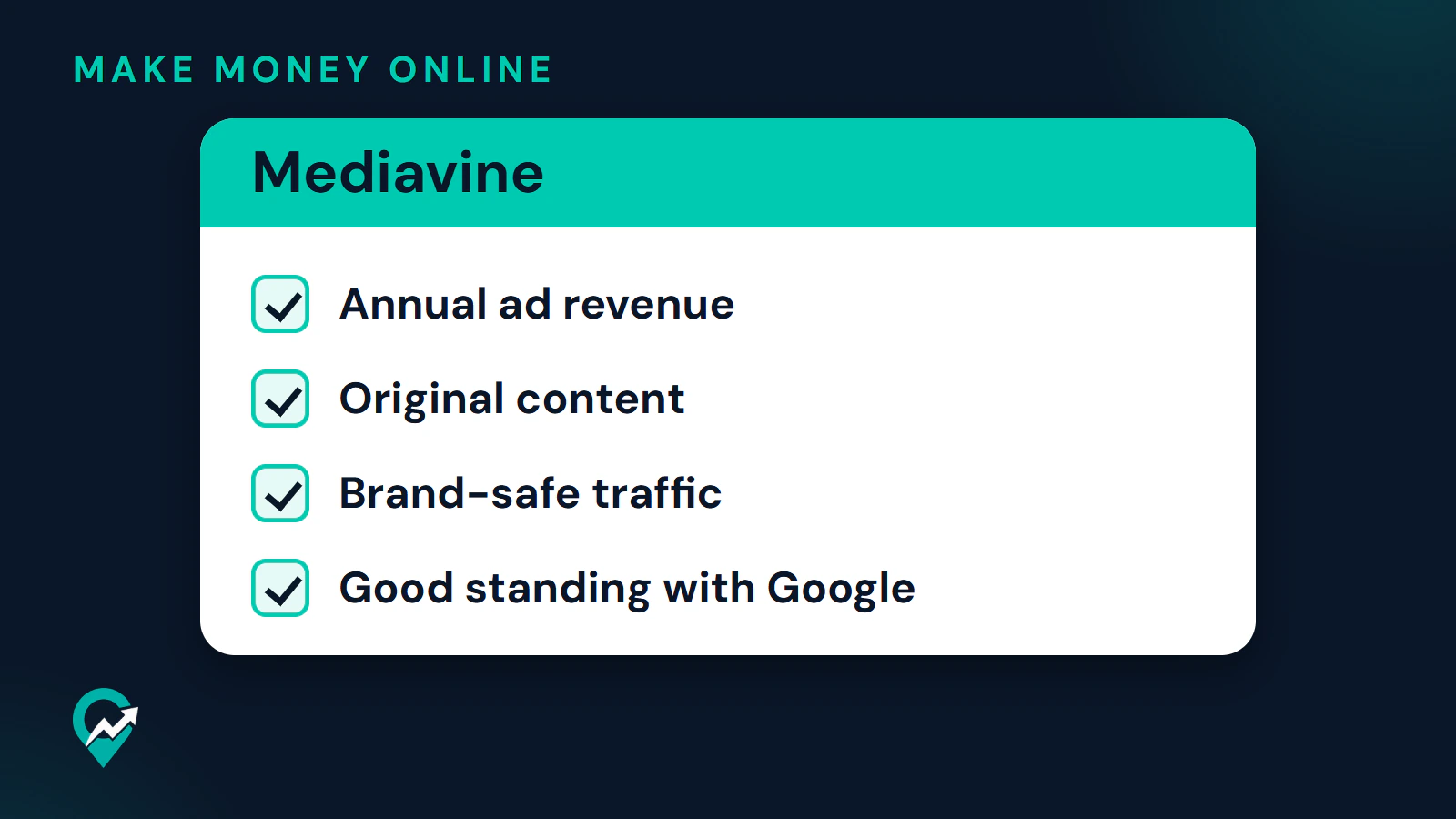
- Generate at least $5,000 in annual ad revenue.
- Publish original content written for the audience.
- Keep its traffic clean, human and brand safe.
- Be in good standing with Google AdSense and AdExchange.
- Give readers an experience that supports premium advertising.
The Help Center article on getting approved gives the same four quality points and the same revenue figure. It adds that Mediavine also looks at traffic countries of origin, traffic sources, reader demographics and further quality and safety checks. Neither page says how these factors are weighed.
An older figure you will still see
Mediavine’s own 2023 post on its application process, modified in May 2025, gives 50,000 sessions per month as the minimum traffic to apply. The current requirements page and the Help Center article do not ask for a session count for the main program. They ask for revenue, and sessions only appear in the Journey test. When two Mediavine pages disagree, this guide follows the newer one, and the requirement has clearly changed since that post was written. If another site quotes 50,000 sessions, it is quoting the old rule.
What each requirement means
$5,000 in annual ad revenue
This is money earned from ads on the site over a year. Mediavine’s pages do not say which revenue sources count, over which twelve months, or how the figure is verified. If your ad income comes from one provider, its revenue report is the natural starting point. If it comes from several, ask Mediavine before you apply instead of assuming.
Original content for readers
The Help Center describes this as content built for real users and not just for search engines or ad revenue. A page written mainly to carry ads fits that description badly. The 2023 post adds that Mediavine reads the site’s content, checks images for attribution and permission, and steers clear of topics advertisers avoid.
Clean, human, brand-safe traffic
Mediavine describes this as real visitors, as opposed to bots, incentivized traffic or traffic from sources that put advertisers at risk. Those three are named outright as failing this test. The mix of countries and traffic sources is part of the review. The 2023 post says Mediavine accepts international traffic and looks for a country mix that will be good for revenue, and the August 2026 Journey post says traffic from other countries is not penalized.
Good standing with Google AdSense and AdExchange
The Help Center explains this as having no active policy violations or account issues with Google. The pages read do not say whether an AdSense account is required to apply.
A reader experience that supports premium ads
Mediavine says it wants a site design that gives ads room to perform without disrupting the reader. Page speed and stable layouts are part of that experience. Google’s Core Web Vitals measure loading, responsiveness and visual stability, and Google recommends an LCP within 2.5 seconds, an INP under 200 milliseconds and a CLS under 0.1 (page last updated 10 December 2025).
How to check your own numbers in Google Analytics
Revenue comes from your ad provider’s report. Traffic comes from Google Analytics, which Mediavine says its application now uses to evaluate your traffic.
Google defines a session as a period of time during which a user interacts with your site. By default a session times out after 30 minutes of inactivity. Google also defines engaged sessions as sessions that last 10 seconds or longer, have a conversion event or have 2 or more page or screen views. Mediavine’s 2023 post says it evaluates Sessions and not Engaged sessions, so do not substitute one for the other.
- Go to your Google Analytics property and select the Reports tab.
- Find the session figures. Google lists the Sessions metric in reports such as Acquisition overview, User acquisition and Engagement overview, and in Explorations.
- Set the date range to the last 30 days.
- In an exploration, use the Country dimension, which Google defines as the country from which user activity originated, to see where sessions come from.
- Note your top traffic sources in the same date range.
Google’s own help says session counts are an estimate and can differ slightly between reports, so use one report consistently.
Audit your export with an AI assistant
If you have exported your numbers, an AI assistant can line them up against Mediavine’s text. This prompt works in ChatGPT, Claude, Gemini or any AI assistant. It uses only the requirement text you paste, so the assistant cannot add a rule that Mediavine did not publish. Replace the text in square brackets first.
I run a blog about [your niche]. I want to check my site against Mediavine's published requirements.

The requirement text, copied from Mediavine's official requirements page on [date you read it]: [paste the requirement text].

My numbers for the last 30 days: sessions [number], sessions by country [list the top countries with the number of sessions], top traffic sources [list], and my ad revenue over the last 12 months from [your ad provider]: [amount].

For each requirement in the pasted text, write one line with the requirement, my number and one of "met", "not met" or "cannot tell from this data". Do not add requirements that are not in the pasted text. Then list which items I should check myself in my analytics before applying.
Treat “cannot tell” as a task: the missing information is in your analytics or in Mediavine’s page, not in the assistant.
How the application works
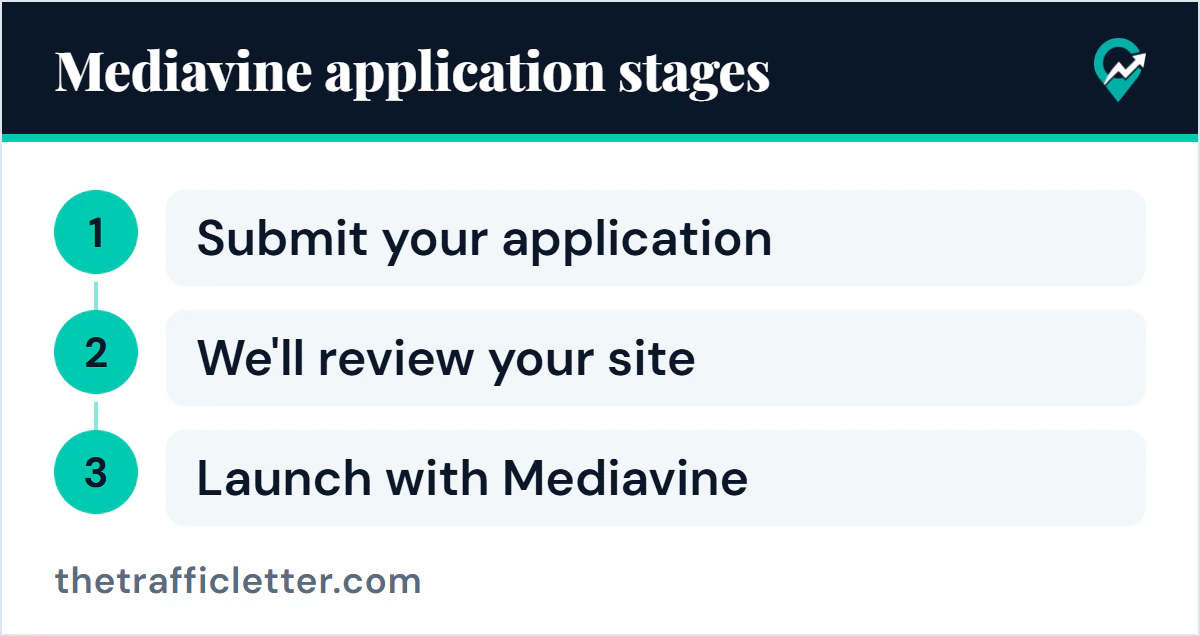
Mediavine says it now has one unified application for all its programs. Its application page, read on 26 October 2026, lets you choose between “I’m a new Publisher” and “I’m an existing Publisher”, then asks for your first and last name, email address, site URL and, optionally, a phone number. The page shows three stages, labeled “Submit your application”, “We’ll review your site” and “Launch with Mediavine”. A progress indicator reads five steps. This guide read only the first screen, because the rest needs your own details, so check what each later step asks.
Mediavine’s August 2026 post says the application evaluates your site and routes you to Journey or to Mediavine, depending on what you qualify for. You do not choose the program.
What you agree to when you join
Before you apply, read three conditions on Mediavine’s Help Center. Mediavine requires exclusive control of your programmatic advertising: you may still run affiliate ads, sponsored work and directly sold inventory, but anything that needs an extra line in your ads.txt file breaks exclusivity. You must sign a traffic assignment letter, which Mediavine says its Terms of Service require. The initial term is 90 days, after which the contract rolls month to month with 30 days’ written notice from either side.
If you are not there yet
If your site is under the $5,000 revenue level, Mediavine’s own route for growing sites is Journey. Its test is 1,000 sessions from Tier 1 countries within a 30-day period, and our guide to how Journey by Mediavine works for growing sites (opens in a new tab) covers it. A Journey site is evaluated automatically for the main program once it reaches the revenue level.
If you are under the Journey test as well, the work is traffic. Our bringing blog visitors in from Pinterest (opens in a new tab) and the plan for growing your Pinterest presence (opens in a new tab) cover the source most blogs in this niche start with. Other networks have different tests, and the full list is in our comparison of ad network requirements (opens in a new tab).
Right after: your next actions
- Pull your last 30 days of sessions, countries and sources from Google Analytics, and your last 12 months of ad revenue from your ad provider.
- Compare them with the requirement list above, and note which of the five you cannot yet prove.
- Read the exclusivity and contract conditions before you apply, then apply on the day you have re-read Mediavine’s requirements page.