

People search for the RPM a blog should earn as if there were a standard answer. The official pages of the networks that report this number do not give one, and this guide shows what they say instead, how to calculate your own page RPM and session RPM, and what moves the result. It reads each page as it stands on 27 October 2026 and sits next to our guide to how ad network entry tests compare (opens in a new tab), which covers the entry tests that come before any RPM.
What RPM means
RPM stands for revenue per mille, which means revenue per thousand. Every network defines the thousand differently, so the first step is to know which RPM a number is.
| Name | What is divided | Defined by |
|---|---|---|
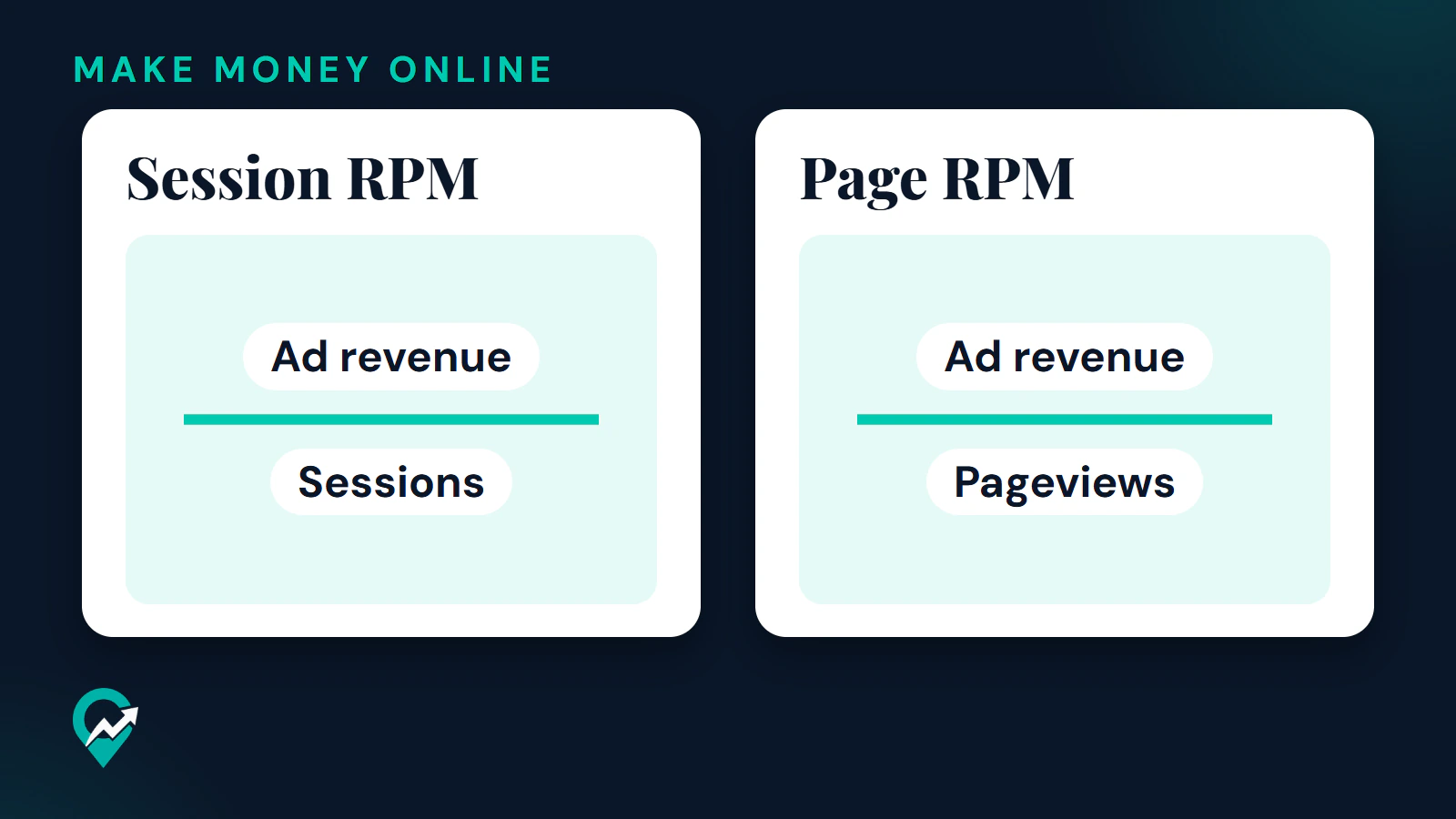
| Page RPM | Estimated earnings divided by page views, times 1,000 | Google AdSense Help |
| Session RPM, called RPM | Total ad earnings divided by sessions, times 1,000 | Raptive, Mediavine |
| Impression RPM | Estimated earnings divided by ad impressions, times 1,000 | Google AdSense Help |
| EPMV | Total ad revenue divided by sessions, times 1,000 | Ezoic |
| Monetized RPM | Revenue divided only by sessions or pageviews where ads ran | Mediavine, Raptive |
Google AdSense says RPM does not represent how much you actually earned. It is calculated from your estimated earnings. AdSense also counts one page view for each page view of a page that shows Google ads, however many ads the page displays.
Raptive’s Help Center, in an article updated on 1 December 2025, uses RPM for earnings per 1,000 sessions and Page RPM for earnings per 1,000 pageviews. Mediavine’s posts from April and May 2026 also define RPM as revenue per thousand sessions. Ezoic’s calculator calls the same session-based figure EPMV and says it cannot be inflated by stacking more ads on a page. That is Ezoic’s own claim, and its page shows no date.
Why the two give different numbers
Raptive explains the gap. A visitor who views several pages in one session raises the session RPM, because the session produced more ad impressions. Each later pageview earns slightly less, because advertisers pay progressively less to reach the same person, so page RPM falls. Raptive concludes that session RPM is always the higher number. It also says revenue per 1,000 sessions tends to be 20 to 25 percent higher than revenue per 1,000 pageviews. That statement describes the relationship between two metrics on its own sites, so it is not a benchmark for yours.
Work out your own RPM: an example with placeholder numbers
The numbers below are invented to show the arithmetic. They are not typical values and not a target. Replace them with your own.
| Placeholder month | Value |
|---|---|
| Ad revenue | 100 |
| Sessions | 10,000 |
| Pageviews | 20,000 |
| Session RPM | 100 divided by 10,000, times 1,000, which is 10.00 |
| Page RPM | 100 divided by 20,000, times 1,000, which is 5.00 |
In a spreadsheet, put revenue in column B, sessions in column C and pageviews in column D, then use =B2/C2*1000 for session RPM and =B2/D2*1000 for page RPM.
To split by traffic source, repeat the sum for each source with that source’s revenue and that source’s sessions. In another placeholder month with 100 in ad revenue and 10,000 sessions, Source A could account for 70 in revenue and 5,000 sessions, giving 14.00, and Source B for 30 in revenue and 5,000 sessions, giving 6.00. Again, these are arithmetic only.
Where the figures come from matters. Revenue comes from your ad provider’s report. Sessions and pageviews come from Google Analytics, where Google defines Sessions as the sessions that began on your site and Views as the web pages your users saw. Google’s help says session counts are an estimate, so use the same report every month.
Why there is no official good RPM
This table shows what the pages read on 27 October 2026 actually state about the level of RPM.
| Source | What it publishes | A level of RPM? |
|---|---|---|
| Google AdSense Help | The page RPM formula and an arithmetic example | No. The example illustrates the formula. |
| Mediavine blog and Help Center | Definitions, dashboard guidance and seasonal explanations | No. A post modified in November 2025 calls comparing individual sites fruitless. |
| Raptive Help Center | Definitions, drivers of RPM, and a ratio between session and page RPM | No level. It states the 20 to 25 percent relationship described above. |
| Ezoic | An EPMV and RPM calculator and an Ad Revenue Index | No. The index is a normalized score from 1 to 100, not a dollar amount. |
Mediavine’s post on improving RPM, updated in October 2023 and modified on 24 November 2025, says there is no short answer. It lists audience, content, site speed and past ad performance among the factors, and says looking for a quick fix or comparing individual websites is a fruitless way to find an answer. Raptive’s article adds that you can earn more overall with a lower RPM than someone else, and that an engaged community can be worth more than high metrics.
Because no official source gives a level, any article that does is quoting something other than an official page. Treat a published range as a claim to check, not a target.
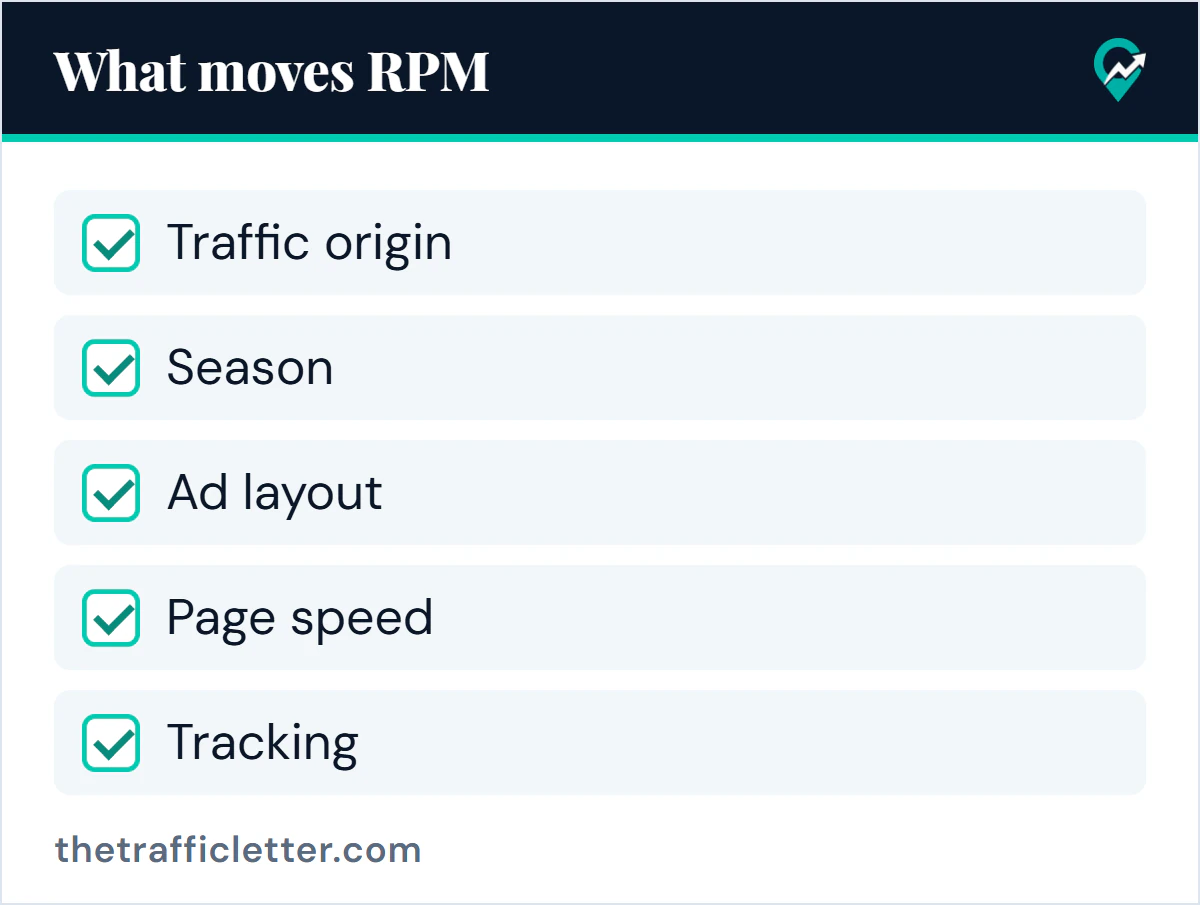
What moves RPM according to official pages
Traffic origin: country, device and source
Raptive’s article on what goes into RPM names the value of each visitor as the first ingredient. It says traffic from the United States is more valuable than international traffic because most advertisers want a US-based audience for US-based products, and that desktop traffic is more valuable than mobile. It says search engine traffic is generally more valuable than social media traffic such as Facebook and Pinterest, because most social visits happen in mobile apps and browsers that block cookies, and because a search history tells advertisers about a visitor’s interests.
Mediavine’s May 2026 post agrees on the direction without giving numbers. It says advertisers bid more aggressively in the United States, United Kingdom, Canada and Australia, and that social traffic often skews lower on the share of sessions where ads served. It adds that this does not make social traffic worthless, because it drives audience growth and brand visibility. For a blog fed by Pinterest, the practical point is to measure the Pinterest sessions on their own, not to judge them by the site average. Our guide to growing blog traffic from Pinterest (opens in a new tab) covers the traffic side.
Season
Mediavine’s January 2026 post says eCPMs, its measure of ad rates, follow seasonal patterns that are mostly predictable. Holidays raise advertiser demand, and quarter-end budgets push spending up as a quarter closes, so Q4 typically outperforms Q1. The post says seasonality is not one-size-fits-all, since a category that is strong in January can be weak in another. Its closing advice is to use trends as a guide, not a guarantee, and not to overreact to short-term dips. The post’s own disclaimer says past performance cannot guarantee future results.
Raptive’s Help Center says RPM typically dips in January after the holiday season. That article was updated in February 2023, so treat it as older. It matches Mediavine’s more recent post on direction. Whatever the cause, compare a month with the same month a year earlier.
Ad layout and impressions
Raptive says advertisers weigh the value of the ad layout, and that viewability, meaning whether the ad is on screen, counts for a lot. It says premium advertisers dislike clutter and that a lighter layout can be worth more than a heavy one. Time on page matters because the longer readers stay engaged, the more chances ads have to refresh.
Mediavine’s Help Center explains impressions per page. It is not the number of ad slots but the number of impressions served, including refreshes, and it calls it the most useful metric in its page-level report because publishers have the most control over it. If a popular post serves few impressions, it suggests asking why.
Page speed and the technical setup
Mediavine lists site speed among the factors behind RPM. A hosting article by BigScoots on Mediavine’s blog, dated 8 October 2026, says hosting affects site speed and Core Web Vitals and that this can ultimately affect revenue. That article is written by a hosting company, so read it as one provider’s view. Raptive’s PageSpeed article, updated on 5 November 2025, says its ad scripts load asynchronously and generally do not hurt field Core Web Vitals, and recommends judging speed by field data. Google recommends an LCP within 2.5 seconds, an INP under 200 milliseconds and a CLS under 0.1 (page last updated 10 December 2025). No official page read here says how much RPM changes per second of load time, so this guide gives no figure.
Tracking and traffic that cannot earn
Standard RPM divides by every session. Mediavine’s April 2026 post says that includes bots, ad-blocked sessions and visits where no ad could serve, which pulls the number down. Its May 2026 post says monetized RPM counts only sessions where at least one ad was served. It lists bots, ad blockers, consent restrictions, regions with low or no advertiser demand and advertiser content restrictions as the common reasons sessions go unmonetized. Raptive’s article on RPM on monetized traffic, updated on 1 June 2026, adds that some Google Analytics 4 implementations can skew the standard figure, and that ads may not run for technical errors, ad blockers, bots or short visits.
Mediavine’s 2019 post, modified in 2020, shows what a tracking error looks like. A wrong or removed analytics code can produce a very high RPM, and a doubled code can double count pageviews and produce a very low page RPM. Mediavine’s page-level guide also advises against sorting pages by RPM from highest to lowest, because pages with little traffic can give an inaccurate calculation.
How to benchmark against your own history
- Pick one unit and keep it. Use session RPM for the overall picture and page RPM for individual pages, and never mix them in one comparison.
- Calculate both every month from the same two sources: your ad provider’s revenue and Google Analytics’ sessions and views.
- Compare each month with the same month of the previous year, not with the previous month, because of season.
- Split by traffic source and by country when your provider’s report allows it, since those are the drivers the networks name.
- Ignore months and pages with very little traffic. Small samples give unreliable RPM.
- Keep a change log with the dates of layout changes, new ad units, theme or plugin updates and tracking changes. If RPM moves on the date of a change, look there first.
- If your network offers a monetized view, record it beside the standard one. A change in the standard figure alone points to traffic quality, and a change in both points to monetization.
Analyse your export with an AI assistant
This prompt works in ChatGPT, Claude, Gemini or any AI assistant. It uses only the numbers you paste, so it cannot invent a benchmark. Replace the text in square brackets first.
I run a blog about [your niche]. Below is my export for the last [number] months, one row per month and traffic source: month, traffic source, ad revenue, sessions and pageviews. Revenue is in [currency] and comes from [your ad provider]. Sessions and pageviews come from Google Analytics.

[paste the export]

For each row, calculate session RPM as ad revenue divided by sessions, times 1,000, and page RPM as ad revenue divided by pageviews, times 1,000. Show the formula and the arithmetic for the first three rows so I can check them.

Then give me one table of session RPM and page RPM by month, and one by traffic source. Compare each month with the same month a year earlier when my data includes it. Flag any row with fewer than [minimum sessions you consider reliable] sessions as too small to trust. Do not use any benchmark, average or figure that is not in my message, and do not tell me whether my RPM is good. End with the three biggest changes in my own numbers and one thing to check for each, such as tracking, season or traffic source.
Check two or three rows by hand before you rely on the table.
Right after: your next actions
- Export your last 12 months of revenue from your ad provider, and sessions and views by source from Google Analytics.
- Calculate session RPM and page RPM for each month with the formulas above, and note which months fall in a holiday season.
- If you are choosing between programs, compare their entry tests first in the guide to Raptive’s eligibility rules (opens in a new tab) and the guide to Ezoic’s requirements (opens in a new tab), since no RPM is available before you are accepted.