


A guest post is an article you write for another blog, usually with a link back to your own. This guide covers guest blog SEO from Google Search Central’s pages: when Google says guest posts are fine, which guest post links its spam policies call link spam, and how both the writer and the host blog should handle links. It belongs to our blog SEO series, which starts with our guide to writing blog posts for search (opens in a new tab); the Pinterest side of search is in our guide to Pinterest SEO for bloggers (opens in a new tab).
Does guest blogging help SEO?
Google’s Search Central blog addressed guest posts directly in a 2017 post by the Google Webspam Team. It says Google does not discourage these articles in the cases when they inform users, educate another site’s audience or bring awareness to your cause or company. What violates Google’s guidelines on link schemes, the post says, is when the main intent is to build links in a large-scale way back to the author’s site.
Google’s current spam policies, last updated in August 2026, keep that line. Among their examples of link spam is “links with optimized anchor text in articles, guest posts, or press releases distributed on other sites.” So a guest post can help you reach the host’s readers and earn a mention of your blog; a guest post written to place keyword links is the practice Google’s pages describe as link spam.
The 2017 post ends with this advice on link building: focus on improving your site’s content, and everything, including links, will follow.
What Google treats as guest post link spam
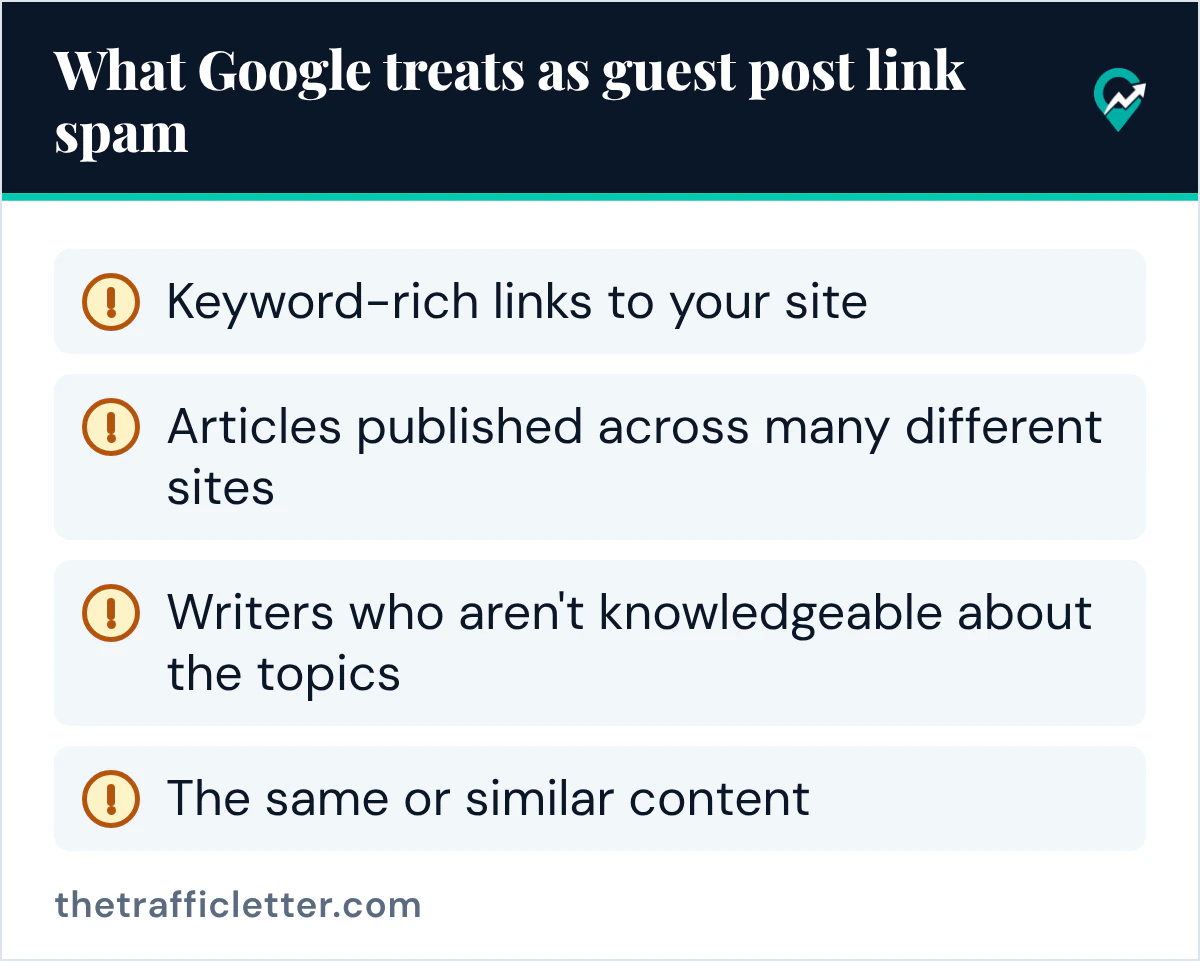
The 2017 post lists factors that, when taken to an extreme, can indicate an article is in violation of Google’s guidelines:
- Keyword-rich links to your site in your articles
- Articles published across many different sites, or many articles on a few large sites
- Writers who aren’t knowledgeable about the topics they’re writing on
- The same or similar content across these articles
The current spam policies list other examples of link spam that can apply to guest posts: exchanging money for links or posts that contain links, exchanging goods or services for links, and excessive link exchanges (“Link to me and I’ll link to you”). Google’s sample of optimized anchor text is a short paragraph about wedding rings in which the keyword phrases are the links.
Paid guest posts: how to mark the link
Google’s spam policies say buying and selling links is a normal part of the economy of the web for advertising and sponsorship purposes, and that it is not a violation of its policies to have such links as long as they are qualified with a rel=“nofollow” or rel=“sponsored” attribute value.
Google’s page on qualifying outbound links says to mark links that are advertisements or paid placements with the sponsored value, and that nofollow is still an acceptable way to flag them, though sponsored is preferred. Its link best practices page says the same in short: if you were paid in some way for the link, qualify it with sponsored or nofollow.
A guest post placed in exchange for money, a product or a service is a paid placement in these terms. Ask the host to qualify the link, or do not take the placement.
How to write a guest post that helps
Google’s 2017 post gives the questions a host blog should ask before it publishes a guest post: Do I know this person? Does this person’s message fit with my site’s audience? Does the article contain useful content? If there are links of questionable intent in the article, has the author used rel=“nofollow” on them? Write the post so that each answer is yes.
- Pitch blogs in your niche, whose readers are the readers you write for.
- Write an original article for that blog. If you republish one of your own posts, Google’s 2017 post advises rel=“canonical” in addition to rel=“nofollow”.
- Link to your blog where it helps the reader, with link text that names the page. Google’s link page says good anchor text is descriptive, reasonably concise and relevant to both pages.
- Keep keyword phrases out of the links. The wedding rings sample in Google’s spam policies shows what to avoid.
The 2017 post also notes that site owners generally prefer not to receive aggressive or repeated “Post my article!” requests. One clear pitch per blog is enough.
Accepting guest posts on your blog
The 2017 post says that when Google detects a website publishing articles that contain spammy links, this may change Google’s perception of the quality of the site and could affect its ranking. Vet each guest post with the questions above before you publish it.
Google’s site reputation policy covers third-party content, which includes content created by freelancers and by people not employed directly by the host site. The policy says having third-party content alone isn’t inconsistent with it; it is inconsistent only when the content is published mainly because of the host site’s already-established ranking signals. A guest post that fits your blog and its readers is the first case. A post on an unrelated topic, placed for its links, looks like the second.
On your own site, qualify any guest post link that was paid for with sponsored or nofollow, as Google’s qualifying links page describes.
A guest post pitch you can draft with AI
This prompt works in ChatGPT, Claude, Gemini or any AI assistant. Read the draft and rewrite anything that does not sound like you.
Write a short pitch email to the editor of [blog name], a blog about [their niche]. I write [your blog] about [your niche]. Propose one guest post titled [working title] that answers this question for their readers: [reader question]. In 4 to 6 sentences, say why the topic fits their audience, what the post will cover that their blog does not already have, and that any link to my blog will point to a page that helps the reader. No flattery, no exclamation marks, one clear question at the end.Guest posts and your other link work
Comments on other blogs follow similar rules in Google’s spam policies; our guide to blog comments and SEO (opens in a new tab) covers them. Whether the blog itself helps your search traffic is in our answer to does a blog help SEO (opens in a new tab).
Right after
- Pick two blogs in your niche whose readers match yours, and pitch one with the prompt above.
- Before you send the post, check every link in it against Google’s anchor text advice, and ask for sponsored on any paid placement.
- Put the same effort into the posts on your own blog, using our blog post writing method for SEO (opens in a new tab).