

Google’s SEO starter guide picks a recipe blog as its example of how people find a site through images. This guide turns Google Search Central’s pages into SEO steps for food bloggers: the recipe itself, the photos, the Recipe structured data, the words cooks type and the links. The method for any post is in our guide to writing blog posts for Google (opens in a new tab), and how Pins bring readers to the same recipes is in our guide to how Pins rank on Pinterest (opens in a new tab).
What SEO for food bloggers covers
Google’s starter guide describes SEO as helping search engines understand your content and helping users find your site and decide whether to visit it. It says many people search visually, and gives this example: “if you have a recipe blog, people might find your content by searching for “fruit tart recipes” and browsing photos of various types of fruit tarts.”
A food blog has two jobs, then. The text has to answer a cook’s question, and the page has to tell Google what the recipe is, through clear photos and structured data. The starter guide adds that compelling and useful content will likely influence your presence in search results more than any of its other suggestions, so the recipe comes first. For the SEO steps that apply to any blog, read our list of SEO tips for bloggers from Google (opens in a new tab).
Write each recipe from your own kitchen
Google’s helpful content page asks whether your content clearly demonstrates “first-hand expertise and a depth of knowledge”, for example expertise that comes from having actually used a product or service. A recipe you cooked can show it: the pan you used, the step that went wrong the first time, the swap that worked, how long the dough really took to rise in your kitchen.
The same page asks whether the content provides original information and whether it avoids simply copying or rewriting other sources. A recipe that restates the top results adds little. Your own tests, timings and photos are the original information that question is about.
The page also lists warning signs of search engine-first content. Two of them fit food blogs well: “Are you writing to a particular word count because you’ve heard or read that Google has a preferred word count? (No, we don’t.)” and “Are you mainly summarizing what others have to say without adding much value?” Write the introduction your recipe needs, not a length you guess Google wants. For the length question, see our look at blog post length and SEO (opens in a new tab).
Google’s page also asks whether it is self-evident who authored the content, and encourages bylines where readers might expect them. Sign each recipe and link the byline to an About page.
Photograph the dish and place each photo near its step
The starter guide asks for images that are sharp and clear, placed near text that is relevant to the image, because the nearby text helps Google understand what the image is about. In a recipe post, the photo of the shaped dough goes next to the shaping step, and the photo of the finished dish goes near the recipe name.
Google’s image guide adds three points that apply to every food photo:
- Use short, descriptive file names. The guide says my-new-black-kitten.jpg is better than IMG00023.JPG, and that the file name gives Google very light clues about the subject.
- Write alt text. The guide calls it the most important attribute when it comes to providing more metadata for an image, and warns that filling it with keywords may cause your site to be seen as spam.
- Keep pages fast. The guide says high-quality photos appeal to users more than blurry ones, while images are often the largest contributor to overall page size. Compress photos before upload and test the page with PageSpeed Insights, which the guide links.
For the Recipe image property, Google’s recipe guide asks for an image of the completed dish. It recommends multiple high-resolution images, with a minimum of 50K pixels when multiplying width and height, in the aspect ratios 16x9, 4x3 and 1x1. It also says the image property has no impact on the image chosen for a text result image: for that, follow the image SEO best practices above.
Add Recipe structured data to each recipe
Google’s recipe guide says that when you provide information such as reviewer ratings, cooking and preparation times and nutrition information, Google can better understand your recipe and present it to users in interesting ways. Recipes can appear in Google Search results and Google Images.
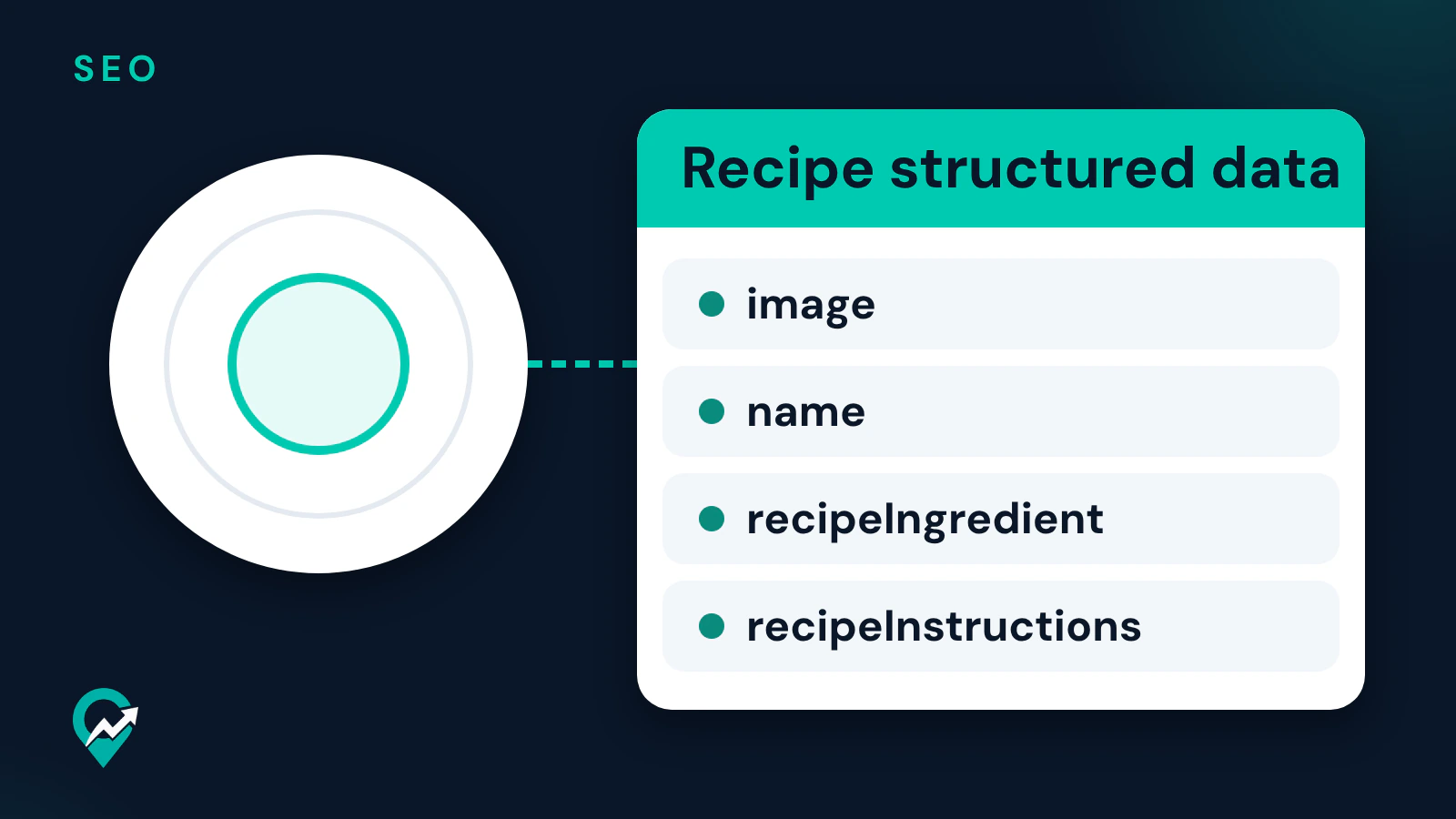
The guide lists two required properties and a set of recommended ones:
| Property | What Google’s recipe guide asks |
|---|---|
| image (required) | Image of the completed dish |
| name (required) | The name of the dish |
| recipeIngredient | An ingredient used in the recipe, with only the text needed to make the recipe |
| recipeInstructions | The steps to make the dish; Google recommends HowToStep |
| prepTime and cookTime | Durations in ISO 8601 format, always used together |
| recipeYield | The quantity produced; required if you give nutrition per serving |
| nutrition.calories | The calories in each serving |
| recipeCategory and recipeCuisine | The type of meal or course, and the region of the recipe |
| keywords | Other terms such as the season, the holiday or descriptors like quick or easy |
| author and datePublished | Who wrote the recipe and when it was published |
The guide also sets limits. Recipe structured data is for content about preparing a particular dish: it gives “facial scrub” and “party ideas” as names that are not valid for a dish. Keywords should not repeat a tag that is really a recipeCategory or recipeCuisine. If your markup breaks the policies, Google says your recipe might not show up as a rich result, but your content will still appear in Search results.
If your food blog runs on a CMS, Google’s recipe guide notes that it may be easier to use a plugin that is integrated into your CMS than to write the code by hand. Whatever writes the markup, check that its values match what the reader sees on the page. The recipe card can also feed Pinterest: our guide to rich Pins for recipes and articles (opens in a new tab) explains what Pinterest reads from the same page.
How to add and test the markup
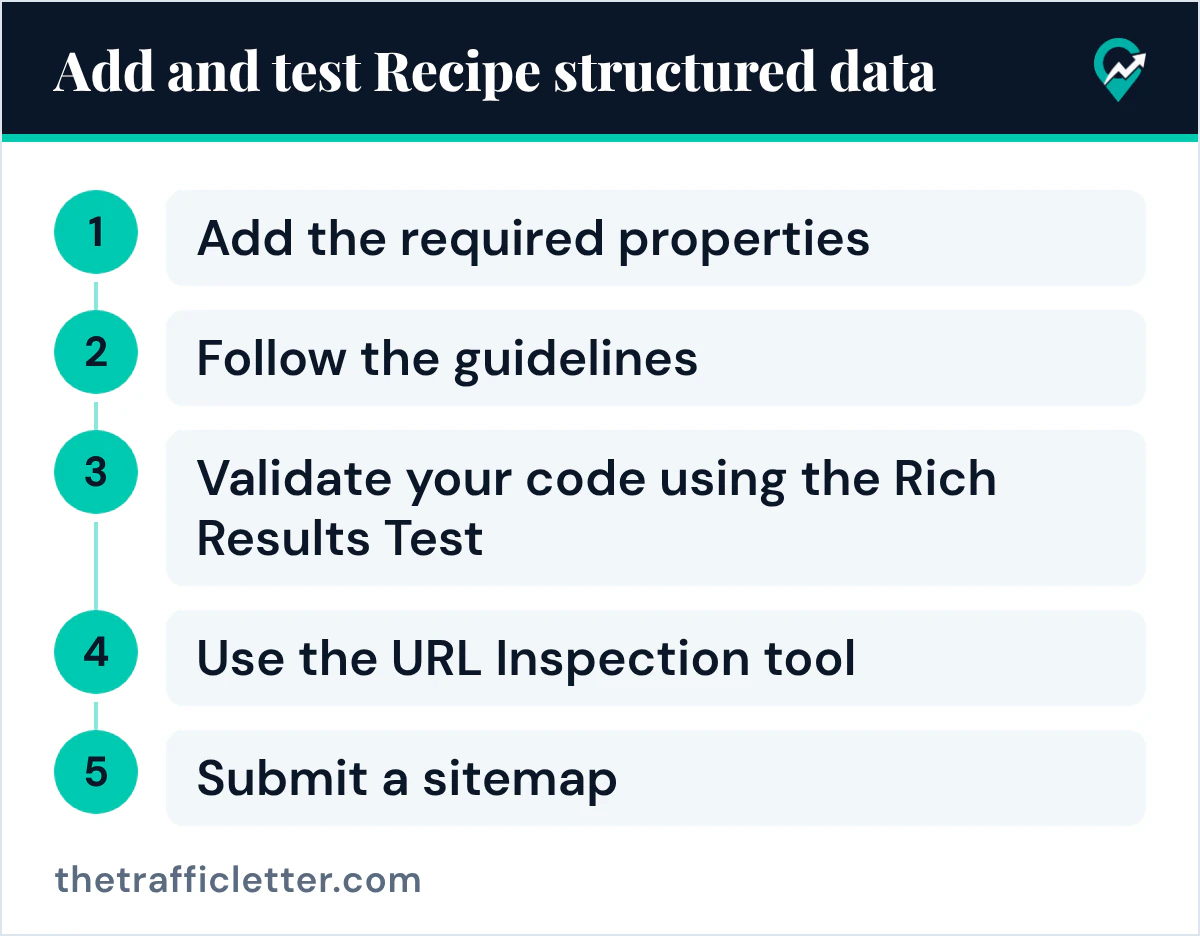
Google’s recipe guide gives this order:
- Add the required properties.
- Follow the guidelines.
- Validate your code using the Rich Results Test and fix any critical errors.
- Deploy a few pages and use the URL Inspection tool to test how Google sees the page. Check that the page is not blocked by a robots.txt file, the noindex tag or login requirements.
- Submit a sitemap to keep Google informed of future changes.
The guide adds that it may take several days after publishing a page for Google to find and crawl it.
Recipe carousels need a summary page
Google’s guide describes a recipe host carousel that lets users explore your recipe gallery pages. To be eligible for a carousel or grid, it asks for ItemList structured data that summarizes the recipes, and says your site must have a summary page that lists all the recipes in the collection. A category page such as “Weeknight pasta” that lists its recipes can be that page.
Use the words cooks search for
Google’s starter guide asks you to think about the words a user might search for, and its example is a food one: some users might search for “charcuterie”, while others might search for “cheese board”. Name the dish the way your readers say it, and mention the other common name in the text when it fits. The guide adds that you don’t need to anticipate every variation, because Google’s language matching systems can understand how a page relates to many queries.
Titles and descriptions follow the same rule. The starter guide says a good title is unique to the page, clear and concise, and accurately describes the contents of the page. A good meta description is short, unique to one page and includes the most relevant points of the page. For a recipe, you can name the dish, the main method or constraint, and the time it takes.
Keep ads and affiliate links in their place
If your food blog runs ads or affiliate links, Google’s pages set some limits. Google’s starter guide asks you not to let ads become overly distracting or prevent users from reading your content. Google’s page experience page lists, among its self-assessment questions, whether your content avoids an excessive amount of ads that distract from or interfere with the main content, and whether your pages avoid intrusive interstitials.
For links to pans, ingredients or kitchen tools, Google’s page on qualifying outbound links asks you to mark advertisements or paid placements with rel=“sponsored”. Google’s spam policies define thin affiliation as publishing content with product affiliate links where the descriptions and reviews are copied directly from the original merchant without any original content or added value. A link under your own note on why you use that pan is the opposite. Where links fit in a recipe post is covered in our guide to affiliate links in food blog posts (opens in a new tab).
Check your recipes in Search Console
Google’s recipe guide recommends checking Search Console after deploying structured data for the first time, after releasing new templates or updating your code, and when analyzing traffic periodically. After Google has indexed your pages, the relevant rich result status report shows valid and invalid items. The guide’s steps for issues are to fix the invalid items, inspect a live URL to check if the issue persists, and request validation using the status report.
The guide says an increase in invalid items after a change may mean you rolled out a new template that doesn’t work. It also says a decrease in valid items, not matched by an increase in invalid items, may mean you are no longer embedding structured data in your pages. Look at the report after each update.
An AI prompt for recipe description and keywords
This prompt works in ChatGPT, Claude, Gemini or any AI assistant. Google’s AI guidance asks you to factcheck and review AI-generated content for accuracy before publishing, and says this review also applies to metadata, so check each line against your recipe.
I write a food blog. Here is my recipe: [paste the recipe name, ingredients, steps and your notes]. Write two things for its Recipe structured data. First, a description: one or two sentences that summarize the dish, using only facts from my recipe. Second, keywords: 3 to 5 comma-separated terms for the season, the holiday or descriptors such as quick or easy. Do not use a term that is a meal type or a cuisine, because those belong in recipeCategory and recipeCuisine. Do not invent cooking times, servings or nutrition.Right after
- Go through the general list of Google’s SEO tips for any blog (opens in a new tab) and fix what your food blog misses.
- Make a Pin for each new recipe with our steps for Pins that send readers to a post (opens in a new tab).
- Plan the next recipes as a group of linked posts with our plan for topic hubs and linked posts (opens in a new tab).